They say nobody does pomp and ceremony like the British... it seems we have a pageant or civic ritual for everything and anything. Over the last week or so I've had recourse to ponder over this.
A couple of weeks ago I had the privilege of bearing witness to the passage of the Olympic Flame through my own home town - Alcester. It was touch and go whether or not I made it as my father had was due to return home from hospital the day before and I was supposed to be at a training weekend for the holiday camp I help out at. In the end things worked out in my favour - my father came out a day early and needed my help providing transport and a close friend's baptism came up on the Saturday evening. These two facts resulted in me leaving the training weekend early and getting a much needed night's sleep in time for the torch to arrive on the Sunday.
Early on the Sunday morning (prior to road closures), I drove my parents to the spot they had picked to watch the relay. Several residents had not heeded the warning to clear the area of their vehicles which were covered in police tape, ready to be towed away. I then planted myself strategically outside Lloyds TSB at the end of the High Street. I felt certain this was a good spot because the bank are cosponsors of 2012 and was hedging my bets that it would be one of the handover locations. I was a good two hours early for the relay and I chatted with those around me to pass the time.
Roughly one hour before the torch was due to arrive, a bus travelled towards my vantage point and I was thrilled to see that it was plastered with Christian slogans and there was a band playing praise and worship songs on board the top deck. I later discovered the bus had been following the relay route all the way from Escall's Methodist chapel, not far from Land's End. You can learn more about the efforts and aims of the Praise bus by following t
his link. It was wonderful to see a group of Christians throwing themselves into a secular ceremony and contributing to the glory of God.
As the time drew near, the crowds swelled along the High Street and indeed occupied every square inch of pavement, every window opening as far as the eye could see. The streets, already decked with bunting for the Jubilee and adorned with the hanging baskets Alcester is renowned for, bristled with colour as Olympic bunting and flags were draped in any spare spot that could be found. Children jumped up and down with excitement as entertainers kept the crowd's attention in the run up.
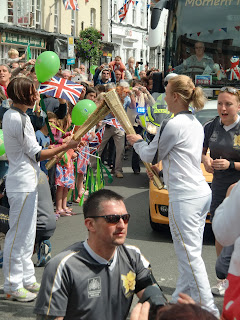
It was then that the first coach arrived and dropped off a relay runner right under our noses. Kids encircled her... straining to touch the torch or posing for photographs. A few moments later the outriders shot down the High Street, giving high fives to all the bystanders. This was followed by what I considered to be a fly in the ointment... a light blue bus with an "Ali G" type MC and dancers. I didn't mind the dancers, but the dialogue wasn't appropriate to the event. It reflected London more than Britain and was to my mind an aberration. It was gilding the lily... it was an unnecessary addition to the occasion.
 |
| An Olympic Torch |
Finally, the magic moment arrived and we were there... right in front of the flame as it transferred from one torch, to the next. The air was filled with electricity and the crowd went wild... and then as quickly as the moment seemed to come, it passed... the crowds mingled together, sharing their experiences before finally dissipating into their respective Sunday routines.
 |
| The Olympic Flame is Passed |
You can see more of my pictures of the Olympic torch relay passing through Alcester, by following
this link.
Not long after this took place I was down to preach and one passage from the Lectionary struck me as being relevant to the ceremonial nature of the torch relay, it also happened to continue along the theme I have felt burdened to preach over recent weeks. The passage was
2 Samuel 6:1-19 and it concerned King David's attempts (and eventual success), to bring the Ark of the Covenant to Jerusalem.
Probably ever since its appearance in the 1980's film: Raiders of the Lost Ark, the Ark has gained a greater general cultural awareness and a reputation for being a weapon of mass destruction. However what made it special? Why was David so keen to bring the Ark into his shining new capital?
The Ark symbolised God's presence among the people of Israel; more than this, it symbolically defined their relationship with Him. It contained artifacts that represented God's favour, provision and Israel's dependence and failure to keep his commands (a jar of manna, Aaron's staff and the original stone tablets of the Law). It was also the centrepiece of the rituals and sacrifices that represented the atonement for the sins of the Israelites.
Yet for the entirety of Saul's reign, the Ark had not been enquired after... aside from a troublesome adventure with the Philistines, it had gathered dust in a place called Shiloh. In seeking to bring the Ark to Jerusalem, David was making a statement - "this kingdom is going to be a kingdom with God at its very heart, where God's reign is of more importance than my own."
What I like about the 2 Samuel account, is that it isn't just a story about success... it is also a story about how when we don't pay attention to God's plans, we can fail... and crucially how after we have failed, God doesn't give up on us but provides us the guidance and strength to ultimately succeed.
I'd like you to try and visualise yourself 3 millennia ago. Imagine you are lining the streets with eager anticipation, awaiting the spectacle of the Ark as it passes by you on its way to Jerusalem. If that seems hard for you to do... picture yourself among the crowds awaiting the Olympic Torch, with that expectation of a special moment. Then all of a sudden.... there is a commotion... the crowds part... and you see this:
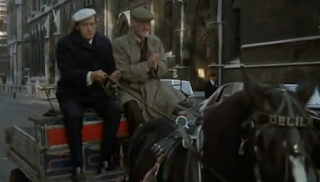 |
| Imagine if Steptoe & Son had transported the Ark or the Torch. |
Not exactly the most dignified form of transport is it?
What a let down it would be if the Olympic Torch had just been towed through town on the back of a tractor. A cart is not the most graceful method of getting from A-B but I suppose in David's eyes it was a quick way to get the Ark home.
The trouble was that the Ark was not just an item of cargo... it wasn't a mere object, it represented God... the divine person. Nobody likes to be treated as an object... we all desire to be valued and that is as true of God as it is of any of us. The truth is that we can all fall prey to the danger of church trappings and ... and glorify a building or a worship style instead of the divine Person. David is not alone by any means and he had got the right initial idea... but in his enthusiasm to get the job done he was ignoring God's ways. This event occurred at the very start of David's reign over a unified Israel... an Israel that as a kingdom had for the very first time an uncontested capital. This was an opportunity for Israel to get to know God in a new way, a special way at the beginning of this new and exciting episode in their story. Speed was not of the essence... acknowledging and praising God was.
Events take an unfortunate turn when a man named Uzzah tries to stop the Ark toppling over onto the road. All he does is reach out and touch it... but that's enough to result in fatal consequences. The Bible records in the episode that God's anger burned against Uzzah. On the surface that seems very harsh, after all, Uzzah's intentions were good intentions. I think there are two very important things to remember that help explain this. The first and most important point is that God cannot look on sin. Before Christ's once and for all sacrifice, mankind's cards were marked. When God looks at those who believe and trust in Him now, he sees Christ's blood covering and atoning for our sins. Prior to that as I have already mentioned, sacrifices needed to be made that foreshadowed the grace that was coming to man. However sin was still there to be seen and without grace, we are literally allergic to the holiness of God. When God saw Uzzah, he saw the sinful nature that was inside of him and had to act. The second point is that prior to Jesus, God had made special allowances for the transport of the Ark. The Levites were Israel's priestly tribe... and He had given them special dispensation to carry the Ark on poles. Uzzah was not one of those Levites and so his actions were not covered by that dispensation.
In the passage, David moves through several emotions. Firstly he is angry because he had tried to please God and yet it had resulted in an act of judgement and the death of one of his companions. I can easily imagine how that anger may have started out. Isn't it hard to cope with the embarrassment that comes when we stick our necks out for God and put ourselves in a vulnerable position and because of our fallibility, nothing happens or worse, something bad happens... and because we have egos, in our own eyes we are ashamed and it reflects badly on us. If we let our egos get in the way and sit on the throne of our hearts, we can never really please God because we will always be looking to protect ourselves or advance ourselves at God's expense.
Thankfully David is a bigger man than say a predecessor such as Cain. He doesn't let his anger turn to sin and act out of spite. Instead he tries to come to terms with his emotions. At first his anger evolves into fear. Having had a knock to his confidence, David fears God has abandoned him (irrationally given his prior experience), and so he retreats away from his own plan of action.
Here's the truly great thing about David - he is in God's words "a man after God's own heart". He doesn't give up... because he loves God.
John's first epistle teaches us that:
"There is no fear in
love. But perfect love drives out fear, because fear has to do with
punishment. The one who fears is not made perfect in love. We love because he first loved us."
1 John 1:18-19
David's love of God drives out his fear of punishment. After 3 months of prayer, study & meditation... and noting the fact that God has blessed the person whose house the Ark is residing, David realises that his only failure was to not consider or consult how God wanted to proceed... he ignored God's gracious guiding hand.
David's second attempt is 100% successful.
David understood that even as a king, he was subservient to God; he demonstrates this by stripping out of his royal robes to reveal a simple priestly garment... and he dances and praises God with wild abandon before the Ark, as it is processed to its new home.
Even then, David's actions don't go down well with his wife Michal who thinks he is acting beneath himself. However, David's response to her is that he doesn't care how stupid or ridiculous he looks... if it glorifies God, he'll gladly look even more ridiculous.
King David sets us an excellent example - service to God in his eyes is more important than popularity (even with those he is close to), more precious than personal sovereignty over his own life and actions.
We can learn a lot from him and I think by following his example we can spiritually SPICE up our lives:
SEEK how God wants us to achieve his goals... even when we are confident of what those goals are.
PRAY for forgiveness and for guidance when we get things wrong and need help.
Be INSPIRED by God by spending time with him... and then inspire others to do the same.
CENTRALISE God in our lives. Make it evident to all that he is our No.1 priority.
ENJOY being in God's presence and worshipping him, irrespective of what others think. It isn't just a chore or duty... it is a privilege and a joy.
- Have you seen or been a part of the Olympic Torch Relay?
- What experiences do you have of overcoming failure with God?


